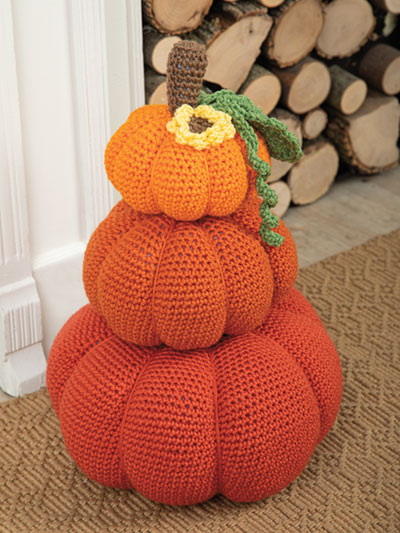
Add a festive Halloween holiday flair with this whimsical stack of Fall pumpkins topped with vines, leaves and a flower. Made using worsted-weight yarn and measures 12″ x 18″.
Designed by Stephanie Smith.
Patterns, projects and techniques

Add a festive Halloween holiday flair with this whimsical stack of Fall pumpkins topped with vines, leaves and a flower. Made using worsted-weight yarn and measures 12″ x 18″.
Designed by Stephanie Smith.

Tapestry crochet is one of those techniques that looks far more complicated than it actually is. You see a beautifully crisp geometric design, a little mountain landscape or a bold retro motif worked directly into the crochet fabric and immediately assume there must be some sort of yarn wizardry happening behind the scenes.
Thankfully, there isn’t.
At its heart, tapestry crochet is simply crochet worked with two or more colours, carrying the unused yarn along inside your stitches and swapping colours as the design requires. Once you get comfortable with changing yarn before finishing the last part of a stitch, suddenly an enormous world of crochet colorwork patterns opens up.
And it is a very addictive world.
I particularly love tapestry crochet for projects where you want the crochet itself to become the decoration. You don’t need piles of appliqués or embellishments afterwards because the picture, lettering or geometric motif is built right into the fabric.
For this roundup I’ve gathered 15 tapestry crochet patterns covering bags, baskets, cushions, wall hangings, blankets, accessories and some smaller projects that are ideal if you’re just getting started. Many are free, and I’ve deliberately included a mixture of beginner-friendly designs and those with enough colour changes to keep experienced crocheters happily counting stitches for an evening or three.
The secret to neat tapestry crochet is tension.
You generally crochet over the colour you’re not currently using, carrying it inside your stitches until you need it again. Keep that carried strand snug enough that it disappears but not so tight that your fabric begins curling or puckering.
When changing colours, make the change during the last yarn-over of the stitch before the new colour begins. It gives you a much cleaner transition.
If this is completely new territory, Highland Hickory Designs has a very useful free tapestry crochet course covering charts, colour changes, yarn carrying, bobbins and even creating your own graphs.
Chevron Tapestry Crochet Clutch – CraftGossip
I’m starting close to home with this free tapestry crochet clutch featured here on CraftGossip. The simple repeating chevron design makes it particularly approachable when you’re learning how to carry yarn and switch colours without having a dozen different shades attached to your project.
A small bag is also quite a forgiving first tapestry project. You get enough repetition to practise the technique properly without accidentally signing yourself up for a queen-sized blanket.
Tapestry Zipper Pouch – Crochet.com
This free pouch by Sara Dudek is worked from the bottom upwards in the round, giving you a useful little introduction to tapestry crochet on a practical project.
Use it for crochet hooks, sewing notions, makeup or all those mysterious little things that accumulate in the bottom of a handbag. I like projects that teach a technique and then earn their keep afterwards.
Free Tapestry Crochet Basket Pattern – Carol Ventura
Carol Ventura has been teaching tapestry crochet for years, and this little spiral basket is a lovely traditional introduction to the technique. The base begins flat before the crochet continues upward to form the sides, while the carried colours create the spiral motif.
Even better, you can vary the finished size by adjusting the base, so once you’ve mastered one you can quite easily end up with a whole nesting family of baskets.
Isabella Tapestry Crochet Basket – Nordic Hook
The Isabella basket has a much more contemporary feel, with a neat geometric colour pattern worked in modified single crochet. The free pattern includes a colour chart and is worked continuously in rounds.
This is exactly the sort of little basket I’d use beside my chair for stitch markers, scissors and the other tiny crochet tools that have a remarkable ability to vanish as soon as I need them.
Diamond Crochet Tote Bag – Spotted Horse Design Co.
A bold diamond motif transforms a straightforward crochet tote into something that looks much more elaborate. This free tapestry crochet bag pattern is a lovely next step once you’re comfortable carrying your second colour.
I’d be tempted to make this in cream and black for a very modern look, although rust, mustard and cream would give it a gorgeous seventies feel.
Silverstone Argyle Cowl – One Dog Woof
Argyle and tapestry crochet were practically made for each other. This free cowl from One Dog Woof uses tapestry crochet to create that classic overlapping diamond appearance without adding separate pieces afterwards.
It’s a nice example of how crochet colorwork doesn’t have to be confined to home décor. Once you understand the technique, scarves, cowls, hats and even garments suddenly become fair game.
Berber Scarf – Lottie & Albert
This monochrome scarf uses a Berber-inspired geometric motif for a very graphic finished piece. The pattern uses tapestry crochet colour carrying through the rows, and the strong black-and-white style makes the motif particularly easy to see developing.
This would be a lovely project if you’re drawn to modern colourwork but don’t necessarily want lots of bright colours.
Free Tapestry Crochet Winter Scarf – Simply Hooked by Janet
For something a little more colourful, this free winter scarf incorporates tapestry crochet into a cosy cold-weather accessory.
Scarves are actually brilliant practice pieces because the repeated rows give you time to settle into your colour-changing rhythm. And if your first few rows are slightly less tidy than the later ones, that’s what scarves and strategically placed coats are for.
Tapestry Crochet Blanket – Spotted Horse Design Co.
If you’re ready to graduate from pouches and potholders, this geometric blanket gives you a much larger canvas for tapestry crochet. The diamond design creates a wonderfully modern look without requiring dozens of different yarn colours.
This is the sort of project I’d choose once the colour-changing technique has become automatic enough that I can crochet while watching television rather than glaring suspiciously at the chart every thirty seconds.
Tapestry Triangles Crochet Pillow – Ned & Mimi
Triangles are particularly effective in tapestry crochet because even a relatively simple graph creates a bold, contemporary design.
This free cushion pattern turns basic colour changes into an eye-catching geometric pillow that would work beautifully in neutral shades, retro colours or something much brighter.
The Mesa Pillow uses tapestry colour changes and bulky yarn, giving the finished cushion plenty of visual impact and texture. It’s an intermediate pattern worked in joined rounds and includes instructions for finishing the cushion with either a zipper or stitched closure.
Bulky yarn also means you aren’t crocheting microscopic stitches for weeks, which is always nice when you’ve decided your sofa urgently needs a makeover.
Modern Hygge Christmas Tapestry Crochet Pillows – Make & Do Crew
These festive cushions are a particularly friendly introduction to tapestry crochet because they’re made primarily with single crochet and straightforward colour changes. Each finished pillow is approximately 20 inches square.
The graphs can be mixed and matched, too. I’d happily make these in muted green, cream and rust and leave them on the sofa well beyond Christmas.
Oh So Boho Crochet Wall Hanging – Bella Coco Crochet
If you’ve been admiring woven wall art but have absolutely no desire to learn another fibre craft just yet, this is a lovely compromise.
The free wall hanging pattern uses tapestry crochet and several earthy colours to create a modern bohemian design, with a video tutorial available to help with the colour changes.
Add fringe and hang it from a wooden dowel or a nicely shaped branch and you’ve suddenly made proper fibre art rather than merely “something else from the yarn basket.”
All You Need Is Love Wall Hanging – Love & Stitch
Lettering is where tapestry crochet becomes particularly fun.
This free pattern uses single crochet colourwork to create a graphic wall hanging featuring words and hearts, with both charted and written guidance available.
Once you’ve made something like this, you begin looking at every crochet graph and thinking, I could put that on a wall hanging.
That is how it starts.
Tapestry Crochet Mushroom Potholder – Raffamusa Designs
Mushrooms continue to sneak into practically every craft category, and I’m not complaining.
This free tapestry crochet potholder combines a vintage-style mushroom motif with a wonderfully practical little kitchen project. The pattern includes a colour chart, and Raffamusa Designs also offers a printable version.
You could use it as an actual potholder, of course, but it would also make a very sweet mini crochet wall hanging.
Free Crochet 8-Inch Tapestry Coffee Afghan Square
If coffee and crochet are two of your preferred food groups, this tapestry coffee afghan square is also worth saving. It uses crochet colourwork to create the graphic design within an eight-inch square, which could be incorporated into a larger blanket or used as the starting point for another small home décor project.
Sometimes making one square is a much friendlier way to practise a new technique than announcing to the household that you’re starting another enormous blanket.
They can look very similar from the front, but the biggest difference is what happens to the unused yarn.
With tapestry crochet, the unused colour is normally carried along inside the stitches. That creates a fairly substantial fabric and lets you swap back and forth between colours quickly.
With intarsia crochet, the different colour sections are usually worked from separate balls or bobbins rather than continuously carrying one strand across the entire row.
Neither technique is inherently better. Tapestry crochet is wonderful for repeating geometric motifs and frequent colour changes, while intarsia is often more practical for large solid blocks of colour.
Most tapestry crochet charts are essentially grids.
Each square represents one stitch and the colour of that square tells you which yarn colour to use. You work across one row of the chart, change colours where indicated, turn if the pattern requires it, and continue with the next row.
Before starting a large project, I strongly recommend making a tiny practice swatch. It lets you work out your yarn tension and colour changes without discovering 37 rows into a blanket that you’ve been carrying your contrast yarn too tightly.
Ask me how craft wisdom like that is usually acquired.
For complete beginners, I’d choose the clutch, zipper pouch or little basket. Smaller projects let you practise carrying yarn and changing colours without managing an enormous graph at the same time.
Once that feels comfortable, move on to one of the cushions or wall hangings. You’ll quickly discover that tapestry crochet has a rather satisfying rhythm to it: stitch, stitch, colour change, stitch, carry the yarn, check the chart and suddenly a picture begins appearing.
And eventually you’ll reach the dangerous stage where you start designing your own graphs.
At that point, practically anything becomes a potential tapestry crochet project — the dog, the house, a favourite flower, a slightly sarcastic phrase for the craft room wall.
You’ve been warned.