Here’s a really cute and useful Lantern Moon Peppermint Candy tape measure I received as an early Christmas gift:

Gauge counts!
What is gauge? It’s the size of the stitches made relative to the yarn and hook used. Sound simple? Well, not really. For instance, you’ll get one ‘gauge’ if you use worsted weight yarn and a G hook to make 4 rows of 12 double crochets. Using the same yarn and hook, I may get a different sized piece. Much of that difference depends on how tightly or loosely I crochet. Other differences come into play in the actual sizing of crochet hooks. All G hooks are not created equal! My Clover Soft Touch G hook is 4.5 mm. Is your favorite G hook also 4.5 mm? Maybe not.
A crochet design will almost always include some disclaimer like ‘use a G hook or the proper hook size to obtain gauge.’ That leaves most of the work up to the crocheter. The designer has already done the design work. Now, the crocheter has to recreate that in a size that works. There’s the rub.
Say a pattern only goes to size 14 and you need a size 16. What do do? You might get lucky and be able to merely increase your hook size to obtain the proper dimensions. That will work better for something not tailored, a simpler design without a lot of shaping. For more tailored designs, you’ll need to rely on math that is currently beyond my pay grade. Kim Guzman is a designer who is currently working on designs suited to and sized for plus sizes. Her designs will be ‘graded’ rather than merely upsized. That is, she’s working on the actual number of stitches required to obtain different sizes with tailored patterns (and some less tailored ones) rather than just increasing the weight of yarn or the size of a hook AND not just increasing the length or width of a garment. This is complicated work that requires a work ethic and devotion to crochet that elude me. Hooray for Kim and other designers who put their energy and talents into such work.
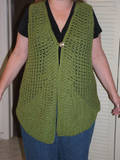
Go to http://www.kimanedesigns.net/ to see some of Kim’s designs and her sizing charts.
Thus, the importance of following gauge in a pattern becomes problematic for many of us. I have a fairly persistent problem in that my stitch width is right on but the stitch height is not. So, I get a gauge swatch (practice piece) that is the right width but not as tall as it should be. I either have to change my hook which doesn’t usually fix the problem, or add an extra loop at the top – often called an extended or Elmore stitch – to attain the right dimensions.
If I’m crocheting an afghan or a scarf, the small variations in my gauge swatch won’t affect much. The biggest problem is that I may well run out of yarn. But, when making a garment, gauge becomes extremely important. I have a daughter who wears a size 00 – 2. (I swear, before she was a teen, I never even knew there WAS a size 00!). Not only must I pay attention to the sizing of garment measurements in patterns for her, I must also pay close attention to my gauge swatch. If I don’t, I’ll create something better suited to a child (my daughter’s 23) or me (size 16)! That would be a great waste of time and yarn.
So, what do you need to determine gauge? You need your pattern (written or in your head), your hook, your yarn (or thread), and a tape measure. Be sure your tape measure is not one that will stretch like some of the older fabric tape measures. Your work your stitch in the prescribed pattern for the prescribed number of rows then measure to see how well you’re following the gauge. To measure it, lay the piece flat on a table with no drag on it in any direction. Then measure it’s height and width. If your piece fits the required measurements, you’re golden. If not, you have to adjust. Using a different sized hook is the likeliest fix. Try that first. If that doesn’t give you a swatch of the required dimensions, you have to try again til you get it right. If your gauge is REALLY off, you’re either crocheting much more loosely or tightly than the designer. That will require some experimentation on your part to determine what the fix will be. It will still probably be a hook size. Just keep trying. If you get really frustrated, find a more experienced crocheter to offer assistance by looking at your swatches. You’ll get there, but it can take some doing. If all else fails, pick a different pattern. No kidding….
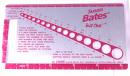
I prefer the multiuse metal gauge tool produced by Susan Bates because it has a rigid 6 inch measure alone one edge and sizing holes for my hooks.
Wonder what’s the difference between ‘tension’ and ‘gauge’? Here’s an article that will help you determine the difference:
http://www.nezumiworld.com/crochet_026.htm
So, if you’ve not been testing your gauge, start now. Make it your New Year’s Resolution (if you HAVE to make one!!).

I saw this and wanted it, lucky you! I looked all over the net for a pattern to make the candy-cane candy, but found nothing to compare with this.
It’s the first time I commented here and I should say you give genuine, and quality information for bloggers! Great job.
p.s. You have an awesome template for your blog. Where have you got it from?
I have the exact same problem as you and have no problem with gauge width but my height is always too short! This poses a lot of problems for me which is why I have more UFO’s (unfinished objects) than FO’s (finished objects). When making garments I have to add extra rows and figure out the proper way to do the increases and as you say, it does require a lot of math. I also started experimenting with some of the Elmore stitches to increase height but not enough to say I’ve found a solution…yet. Other challenges are charted designs and certain crochet square projects that are not entirely worked in the round (my square for a dragonfly pattern wound up being a diamond!). Curiously, my favorite hooks are also Clovers and I wonder if there’s something about those hooks which affects guage height. I must also add that I have two sets of “identical” Clover hooks and some of the hooks of the same size are noticeably different in size.
CATHERINE,
Sorry for taking so long to reply. My gauge remains the same (as far as I can tell) with my Clover hooks as with my Bates – or any others. I’ve actually changed hooks in mid-swatch to see if that was the case. Same for which way I hold my hook. I switch from my usual knife hold to the other method for a few rows if my wrist is tiring. As for variations in hook sizes with the Clovers that you noticed, I guess I’m not surprised. While I find the individual hooks to be well finished (with the exception of the thumb pad in two of them coming unglued), the fact that a hook is mislabeled or mis-sized is not surprising in products mass produced in China.
jd
Anyhow, it certainly can be a challenge!